

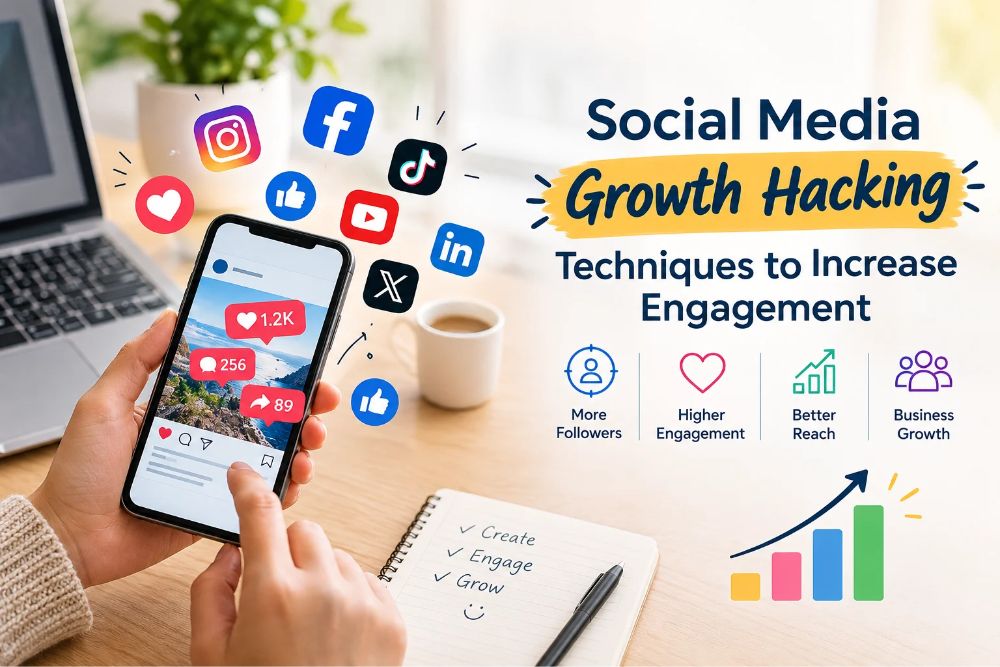
Social media has become an essential channel for businesses looking to build brand awareness, connect with customers, and generate leads. However, simply posting content regularly does not guarantee success. Businesses need effective social media growth hacking techniques to increase engagement, reach the right audience, and achieve sustainable growth.
Social media growth hacking combines creativity, data analysis, audience insights, and experimentation to improve results without requiring a large marketing budget. By implementing the right strategies, businesses can strengthen their online presence and build meaningful relationships with their audience.
What Is Social Media Growth Hacking?
Social media growth hacking is the process of using innovative, cost-effective marketing strategies to increase followers, engagement, website traffic, and conversions. It focuses on identifying what works best for a target audience and continuously improving performance through testing and analysis.
Unlike traditional social media marketing, growth hacking emphasizes measurable results, rapid experimentation, and scalable strategies.
7 Social Media Growth Hacking Techniques to Increase Engagement
1. Create Content Your Audience Wants to See
Understanding your target audience is the first step toward improving social media engagement. Identify their interests, challenges, questions, and preferences before creating content.
Share educational posts, practical tips, industry insights, short videos, and behind-the-scenes content. Focus on providing value rather than promoting products in every post. Relevant content encourages users to comment, share, and save your posts.
2. Use Short-Form Videos to Increase Reach
Short-form videos on platforms such as Instagram, YouTube, and TikTok can help businesses introduce their products, explain services, and communicate ideas quickly.
Create engaging videos with strong opening hooks, useful information, captions, and clear calls to action. Demonstrations, quick tutorials, customer stories, and frequently asked questions are effective formats to test.
3. Encourage Interaction Through Questions and Polls
Engagement improves when audiences have a reason to participate. Use questions, polls, quizzes, and discussion-based posts to invite people to share their opinions.
For example, a digital marketing agency could ask followers which challenge they face most: generating leads, improving SEO, or increasing website conversions. Responding to comments also helps build trust and encourages further conversations.
4. Collaborate With Creators and Relevant Businesses
Collaborating with industry experts, content creators, and complementary businesses can introduce your brand to new audiences.
Choose partners whose followers match your target market. Joint videos, expert interviews, collaborative posts, and educational sessions can expand visibility and create opportunities for meaningful engagement.
5. Optimize Posting Times and Content Formats
Publishing content when your audience is active may improve its initial visibility. Use platform analytics to understand audience activity, then experiment with different posting times and formats.
Track engagement rates, shares, saves, comments, and video watch time. Use these insights to identify successful content patterns and refine your social media strategy.
6. Use User-Generated Content and Social Proof
Customer reviews, testimonials, tagged posts, and user-created content can make your brand feel more authentic. Encourage satisfied customers to share their experiences and request permission before reposting their content.
Real customer experiences can build credibility, strengthen community relationships, and encourage potential customers to interact with your brand.
7. Test, Measure, and Improve Your Strategy
Growth hacking requires continuous experimentation. Test different headlines, visuals, video lengths, captions, and calls to action to discover what resonates with your audience.
Avoid relying only on follower counts. Monitor engagement rate, reach, profile visits, link clicks, leads, and conversions. Focus on metrics that support your business goals.
How Can Businesses Measure Social Media Engagement?
Businesses can measure social media engagement by tracking likes, comments, shares, saves, mentions, and clicks. A common engagement rate formula is:
Engagement Rate = (Total Engagements ÷ Total Reach) × 100
For example, if a post receives 120 engagements and reaches 3,000 people, its engagement rate is 4%. Comparing results across similar posts helps businesses identify effective content strategies.
Conclusion
Social media growth hacking helps businesses increase engagement through valuable content, short-form videos, audience interaction, collaborations, and data-driven experimentation. Instead of chasing vanity metrics, focus on building genuine relationships and achieving measurable business outcomes.
At Manasvi Infotech, businesses can explore digital marketing strategies that support stronger online visibility, audience engagement, and sustainable growth. With consistent testing and audience-focused content, social media can become a valuable channel for long-term business success.
Frequently Asked Questions (FAQs)
1. What is social media growth hacking?
Social media growth hacking uses creative, measurable, and cost-effective strategies to increase engagement, reach, followers, and conversions.
2. Which social media growth hacking technique is most effective?
There is no single best technique for every business. Valuable content, short-form videos, audience interaction, and regular performance analysis are useful starting points.
3. How often should businesses post on social media?
Posting frequency depends on the platform, audience, and available resources. A consistent, sustainable schedule with quality content is generally more useful than posting frequently without a clear strategy.
4. How long does social media growth hacking take to show results?
Results vary by industry, audience, platform, and content quality. Regular experimentation and performance tracking help businesses understand what works over time.

